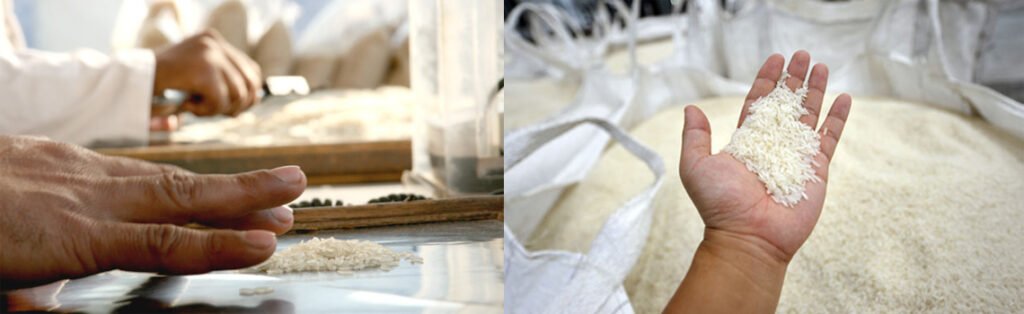
Basmati rice, known for its distinctive aroma and long, slender grains, has been a treasured grain for centuries. Among the varieties of Basmati rice available, export-quality Basmati stands out for its exceptional quality and appeal in the global market. In this blog post, we’ll delve into the essential parameters that define the excellence of export-quality Basmati rice.
1. Purity and Uniformity: Quality Assurance
Stringent quality control measures are at the heart of export-quality Basmati rice production. Each batch undergoes meticulous cleaning, sorting, and inspection to ensure uniformity, purity, and freedom from any impurities or contaminants.
Qualities to check:
- Broken and Fragmented Grains: Export Quality Basmati rice maintains strict standards for broken and fragmented grains. It should not exceed 5.0 percent. (Exceptional case: May contain a higher percentage based on buyer demand.)
- Damaged or Discolored Grains: All grains, including black grains, that have internal damage or discolouration are regarded as being of lower quality.
- Chalky Grains: Chalky grain is grain, at least half of which is milky white in colour and brittle in nature.
- Green Grains: These are grains that are not adequately developed or are green in colour.
- Under-milled or red-striped grains: An under-milled grain is one whose bran portion is not completely removed during polishing or which has substantial bran streaks left on it. Red grains are the kernels, whether whole or broken, that have 25 percent or more of their surface coated with red bran.
- Other Grains (Admixture): As per the national standard for export-quality rice, ‘other grains’ shall be limited. There is a presence of natural admixture that takes place in the cultivation land and is not under human control.
2. Aroma: The Signature Scent of Basmati
The heart and soul of Basmati rice lie in its captivating aroma. Export-quality Basmati rice is renowned for its distinct and enticing fragrance, often described as a blend of nuttiness and floral notes. Due to the presence of substances like 2-acetyl-1-pyrroline, Basmati rice has a rich aroma that is instantly recognizable and in high demand.
3. Grain Length: The Elegance of Elongation
Long, slender grains are a hallmark of export-quality Basmati rice. These grains, typically ranging from 7.5 to 8.6 millimeters in length, are a visual testament to the rice’s superior quality. When cooked, they elongate gracefully and maintain their separation, making Basmati rice the preferred choice for biryani, pulao, and more. After cooking, the Basmati rice should show equivalent breadth-wise expansion but a better lengthwise expansion, with a minimum ratio of 3:5.
4. Texture and Firmness: The Perfect Bite
Export quality Basmati rice achieves a harmonious balance between tenderness and firmness. When cooked, the grains retain a delightful, slightly chewy texture, ensuring a satisfying mouthfeel that leaves a lasting impression.
5. Aging: The Maturation of Flavour
Aging is a crucial step in the journey to perfection for Basmati rice. Export-quality Basmati is aged for at least one to two years, allowing it to mature gracefully. This aging process enhances the rice’s flavour profile, making it richer, less sticky, and even more aromatic.
6. Basmati Variety: The Icons of Flavour
Export quality Basmati rice typically includes revered Basmati varieties such as Basmati 1121, Basmati 1718, Basmati 1509 and Basmati 1401. These varieties have earned their place in the limelight for their exceptional flavour profiles and striking appearances.
7. Moisture Content: Preserving Quality
Moisture is an important factor in retaining a product’s quality and resistance to deterioration. As per FSS Regulations for rice, moisture content shall not be more than 16 percent by weight, ensuring that export quality Basmati rice is properly preserved.
8. Pesticide Residues: Ensuring Safety
Export quality Basmati rice undergoes rigorous testing for pesticide residues. Pesticides, which can have adverse health effects, are strictly controlled to ensure the rice is safe for consumption. This safeguards against skin and eye irritation, reproductive problems, and other health concerns associated with pesticide exposure.
9. Heavy Metals (Lead, Arsenic): Environmental Concerns
Tests are carried out to check for the presence of heavy metals like lead and arsenic in export quality Basmati rice. Contamination by heavy metals, especially lead and arsenic, is a potential environmental threat. Export quality rice adheres to specified limits, ensuring safety for consumers. For example, lead content should not exceed 0.2 mg/kg, and arsenic content should not exceed 1.1 mg/kg.
10. Below Detection Limit: Uric Acid and Aflatoxins
Export quality Basmati rice is tested to ensure that uric acid levels are below 100 mg/kg (detection limit is 10 mg/kg). Aflatoxins, which are carcinogenic substances that can affect rice quality, are also monitored and should not exceed 30 micrograms per kilogram of rice (the detection limit is 1.7 ug/kg).
11. Packaging: The Preservation of Perfection
The packaging of export-quality Basmati rice is designed with the utmost care to preserve its freshness and aroma. It is typically packaged in containers made of jute, cotton, or paper that are clean, dry, and in sound condition, ensuring the rice reaches your kitchen in its prime state.
Conclusion:
Export quality Basmati rice stands as a testament to the artistry of rice cultivation. It isn’t just rice; it’s the embodiment of excellence. When you choose export-quality Basmati rice, you’re not merely selecting an ingredient but a culinary masterpiece. It’s a journey through aroma, texture, and flavour, where every grain tells a story of perfection.
Let export-quality Basmati rice grace your table, and let your culinary creations resonate with the essence of excellence in every bite.